
JEE Main vs JEE Advanced 2027: Complete Guide for TBSE & CBSE Students in Tripura
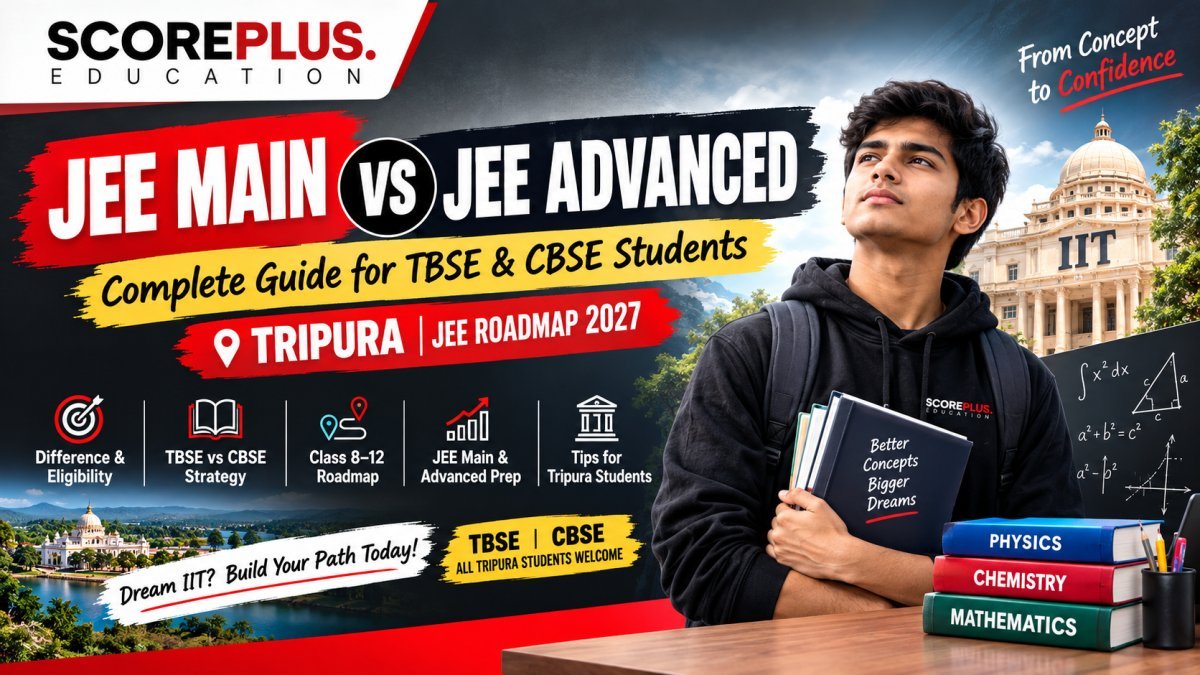
JEE Main vs JEE Advanced 2027: Complete Guide for TBSE & CBSE Students in Tripura
JEE Main or JEE Advanced? Which one should you prepare for? Can a TBSE student crack JEE? Is CBSE better for JEE? When should you start preparing?
If you are a student from Tripura studying in TBSE, CBSE, Vidya Jyoti or another school system, these questions are probably already in your mind.
And if your dream is to study engineering at an IIT, NIT, IIIT or another leading engineering institute, understanding the JEE pathway is one of the first things you should do.
This guide explains JEE Main vs JEE Advanced, the difference between them, how TBSE and CBSE students can prepare, when to start, and how a student from Tripura can build a serious JEE preparation strategy.
Important: Examination rules, eligibility, syllabus and admission procedures can change from year to year. Always verify the latest official information before applying.
What is JEE?
JEE stands for Joint Entrance Examination.
For engineering aspirants, the two major examinations are:
JEE Main → JEE Advanced → IIT
However, JEE Main and JEE Advanced are not simply two levels of the same test.
They have different purposes and require different levels of preparation.
JEE Main is conducted by the National Testing Agency (NTA). Its Paper 1 is used for admission to B.E./B.Tech. programmes at NITs, IIITs, CFTIs and other participating institutions. It is also the qualifying route for JEE Advanced for Indian candidates.
JEE Advanced is the examination through which candidates compete for admission to the IITs, subject to the applicable eligibility and admission rules.
JEE Main vs JEE Advanced: What's the Difference?
JEE MainJEE AdvancedConducted by NTAConducted by an IITMajor route for NITs, IIITs and other participating institutionsRoute for IIT admissionsTests Physics, Chemistry and MathematicsTests Physics, Chemistry and MathematicsStrong emphasis on speed, accuracy and applicationGreater emphasis on deep conceptual and analytical problem solvingImportant for engineering aspirants across IndiaMainly targeted by students aspiring for IITsAlso provides the qualifying route for JEE AdvancedRequires meeting the applicable eligibility criteria
The exact examination pattern and eligibility conditions should always be checked in the official information bulletin for the relevant year.
What is JEE Main?
Think of JEE Main as your first major national-level engineering entrance examination.
For B.E./B.Tech. aspirants, JEE Main Paper 1 covers:
Physics + Chemistry + Mathematics
But don't make the mistake of thinking:
"JEE Main is easy."
It isn't.
JEE Main requires students to combine:
- Conceptual understanding
- Formula application
- Calculation speed
- Accuracy
- Time management
- Question selection
- Previous-year question practice
- Mock-test experience
A student may know the chapter very well but still lose marks because of calculation mistakes or poor time management.
Therefore:
JEE Main preparation = Concept + Practice + Speed + Accuracy
What is JEE Advanced?
JEE Advanced is a different challenge.
It is designed to test whether you can think beyond direct application.
A typical Advanced-level problem may require you to:
- Understand an unfamiliar situation
- Connect multiple concepts
- Analyse conditions
- Select an appropriate approach
- Build a logical solution
- Work through a multi-step problem
Therefore:
JEE Advanced preparation = Concept + Depth + Logic + Problem Solving
This is why simply memorising formulas is not enough for an IIT aspirant.
Is JEE Advanced Only for IIT?
For IIT admissions, yes—the JEE Advanced route is central to the IIT admission process.
For example, under the 2026 rules, Indian candidates had to first qualify through JEE Main and be among the top 2,50,000 successful candidates in the B.E./B.Tech. paper, while also satisfying the other JEE Advanced eligibility conditions.
So an IIT aspirant should not think:
"First I will prepare for JEE Main, and after the result I will start Advanced."
For a serious IIT target, Advanced-level thinking should be developed during preparation itself.
Can a TBSE Student Crack JEE?
Yes. Absolutely.
Your school board does not decide your JEE potential.
A student studying under TBSE can prepare for JEE Main and JEE Advanced.
However, the preparation may need to be planned carefully because school curriculum and competitive-exam preparation are not exactly the same.
The important question is not:
"Am I a TBSE student?"
The important question is:
"How strong are my concepts, and how consistently am I preparing?"
A student from Tripura can prepare for a national-level examination without assuming that success is possible only after moving to another city.
What About CBSE Students?
CBSE students also need dedicated competitive preparation.
Being a CBSE student does not automatically mean being JEE-ready.
School examinations generally focus on your academic curriculum.
JEE preparation demands additional:
- Problem solving
- Application
- Time management
- Competitive practice
- PYQs
- Mock tests
- Error analysis
Therefore, whether you study in CBSE or TBSE, your JEE preparation needs to go beyond simply completing your school syllabus.
TBSE vs CBSE for JEE: Which is Better?
This is one of the most common questions asked by students and parents.
The better question is:
Which preparation system will help me build stronger fundamentals and competitive problem-solving skills?
Your board is only one part of your preparation.
A serious JEE aspirant needs:
School + JEE preparation + Practice + Testing + Revision
So don't waste your preparation time worrying that your board automatically puts you behind.
Instead, identify your academic gaps and work on them systematically.
When Should a Tripura Student Start JEE Preparation?
There is no single compulsory starting age.
But preparation can be divided into stages.
Class 8–9: Foundation
This is the time to build strong fundamentals.
Focus on:
- Arithmetic
- Algebra
- Geometry
- Number systems
- Basic trigonometry
- Logical thinking
- Calculation
- Problem-solving habits
Don't try to turn Class 8 into Class 11.
Build the foundation first.
Class 10: Foundation + Competitive Thinking
Class 10 is a very important transition stage.
Students should aim to become strong in:
- Algebra
- Geometry
- Trigonometry
- Coordinate geometry
- Equations
- Basic mathematical reasoning
Board preparation should remain important while students gradually learn how competitive questions differ from routine school questions.
Class 11: The Real JEE Journey
For most students, Class 11 is where serious JEE preparation begins.
You now enter the full:
Physics + Chemistry + Mathematics
cycle.
This is the stage where students should develop a structured routine.
Learn
Understand the concept.
Practise
Solve progressively difficult problems.
Analyse
Understand why questions were wrong.
Revise
Return to older chapters regularly.
Test
Measure your actual performance.
This cycle should continue throughout preparation.
Class 12: Boards + JEE
Class 12 can become stressful because students have to manage:
Board Exams + JEE Main + JEE Advanced
The solution is not to ignore boards.
Nor should you prepare for boards and JEE as completely unrelated subjects.
Instead, use your school syllabus as the academic foundation and take the concepts to a competitive level through additional practice.
A Simple JEE Roadmap for Tripura Students
Class 8–9
Foundation
↓
Class 10
Strong School Concepts + Competitive Exposure
↓
Class 11
Complete JEE Preparation
↓
Class 12
Syllabus Completion + Revision + PYQs + Tests
↓
JEE Main
Speed + Accuracy + Strategy
↓
JEE Advanced
Deep Thinking + Advanced Problem Solving
↓
Engineering Admission
This is a much healthier approach than trying to complete everything at the last moment.
What Should You Focus on for JEE Mathematics?
For mathematics, don't build your preparation around memorising formulas.
Build it around understanding.
Important areas include:
Algebra
- Quadratic Equations
- Sequences and Series
- Complex Numbers
- Binomial Theorem
- Permutations and Combinations
- Probability
Coordinate Geometry
- Straight Lines
- Circles
- Conic Sections
Calculus
- Limits
- Continuity
- Differentiation
- Application of Derivatives
- Integration
- Differential Equations
Trigonometry
- Ratios
- Identities
- Equations
- Applications
Vectors & 3D Geometry
These are only broad areas. Students should follow the official syllabus for their examination year, rather than relying on old chapter lists. NTA publishes the JEE Main information bulletin and syllabus through its official website.
JEE Main Strategy: What Should You Do?
For JEE Main, focus strongly on:
1. Strong Basics
Don't leave fundamental concepts unclear.
2. PYQs
Previous-year questions help you understand how concepts are tested.
3. Timed Practice
Learn to solve questions within examination constraints.
4. Accuracy
A fast wrong answer is still a wrong answer.
5. Mock Tests
Regular tests help identify weaknesses.
6. Error Analysis
Maintain an error notebook.
Record:
Question → Mistake → Reason → Correct Approach
This simple habit can significantly improve preparation quality.
JEE Advanced Strategy: What Changes?
Advanced preparation requires greater depth.
Instead of asking:
"Which formula should I use?"
start asking:
"What information is hidden inside this question?"
Develop:
- Observation
- Logical reasoning
- Multiple-concept application
- Mathematical modelling
- Alternative approaches
- Patience with difficult problems
You should become comfortable with questions that don't immediately tell you what method to use.
The Biggest Mistake JEE Students Make
One of the biggest mistakes is collecting resources instead of solving problems.
Students often jump between:
- Different teachers
- Different books
- Different apps
- Different YouTube channels
- Different notes
- Different test series
The result?
A huge amount of content—but incomplete preparation.
Instead:
Choose a structured system and follow it consistently.
You don't need ten explanations of the same chapter.
You need to understand one explanation properly and then solve.
Another Common Mistake: Ignoring Mistakes
Suppose you solve 50 questions and get 10 wrong.
Don't immediately rush to another 50.
First ask:
Why were those 10 wrong?
Maybe:
- 3 were conceptual mistakes
- 2 were calculation mistakes
- 2 were careless mistakes
- 2 were due to misunderstanding the question
- 1 was due to time pressure
Now you know what to improve.
This is called error analysis, and it should become a regular part of JEE preparation.
Can You Prepare for JEE from Tripura?
Yes.
The key is not simply where you study.
The key is whether you have access to:
Good teaching + structured syllabus + quality practice + tests + revision + doubt support
Students in Tripura can combine:
- School education
- Offline classes
- Online classes
- Recorded lessons
- Practice sheets
- PYQs
- Mock tests
- Digital learning resources
The important thing is to avoid studying without a plan.
For Parents in Tripura
Parents often ask:
"Does my child need to go outside Tripura for JEE preparation?"
There is no universal answer.
Every student is different.
Before making such a decision, evaluate:
- Quality of teaching
- Student's consistency
- Academic foundation
- Test performance
- Doubt support
- Study environment
- Discipline
- Financial practicality
The objective should always be:
Find the learning environment in which the student can consistently improve.
JEE Main or JEE Advanced — Which Should You Target?
If your target is NIT/IIIT and other JEE Main-based engineering opportunities:
Target JEE Main strongly.
If your dream is IIT:
Prepare for JEE Main + JEE Advanced.
If you are in Class 8–10:
Don't worry about choosing one immediately.
Build your foundation.
If you are in Class 11:
Start structured JEE preparation.
If you are in Class 12:
Focus on:
Completion → Revision → PYQs → Tests → Analysis
ScorePlus Education: From Concept to Confidence
At ScorePlus Education, we believe competitive preparation should begin with clarity—not pressure.
For students from Tripura, our focus is to build a learning pathway that connects:
School Mathematics → Strong Fundamentals → Competitive Problem Solving → JEE Preparation
Whether you are a TBSE student, CBSE student or studying in another school system, the objective remains the same:
Understand the concept.
Learn how to apply it.
Practise the right questions.
Analyse your mistakes.
Improve consistently.
Because JEE preparation is not about studying everything.
It is about studying the right things, in the right order, consistently.
Final Message for Tripura JEE Aspirants
You don't need to start by asking:
"Can I crack JEE?"
Start by asking:
"What can I improve today?"
One chapter.
One concept.
One problem.
One mistake.
One improvement.
Then repeat.
Your school may be in Tripura.
Your preparation may happen from Tripura.
But your ambition can be national.
From Concept to Confidence.
ScorePlus Education
Guiding students from strong fundamentals to competitive excellence.
Frequently Asked Questions
1. Can TBSE students appear for JEE Main?
Yes. Students meeting the applicable eligibility requirements can appear for JEE Main irrespective of whether they studied under TBSE or CBSE. Always check the current year's official NTA information bulletin.
2. Can TBSE students crack JEE Advanced?
Yes. Your school board does not by itself prevent you from preparing for or appearing in JEE Advanced. You must satisfy the eligibility criteria applicable to that examination year.
3. Is CBSE better than TBSE for JEE?
The board alone does not determine JEE success. Students from either board need dedicated competitive preparation.
4. Is JEE Advanced harder than JEE Main?
Generally, JEE Advanced requires a deeper level of conceptual and analytical problem solving. However, students should prepare according to the official examination requirements rather than relying only on labels such as "easy" or "hard."
5. Can I prepare for JEE from Tripura?
Yes. With structured teaching, appropriate study resources, regular practice, testing and consistent guidance, students can prepare for national-level competitive examinations from Tripura.
6. When should I start JEE preparation?
Building strong fundamentals during Classes 8–10 can be helpful, while Classes 11–12 are generally the key years for systematic JEE preparation. The right starting point depends on the student's academic foundation and goals.
7. Should I prepare for JEE Main and JEE Advanced separately?
Not completely. If IIT is your target, your preparation should develop both strong JEE Main performance and deeper Advanced-level problem-solving ability.
8. Is JEE preparation only for toppers?
No. But serious preparation requires consistency, patience and willingness to improve. Your starting level is less important than your willingness to build your skills systematically.
Official Information
For the latest examination rules, syllabus, application information and eligibility conditions, students should use the official websites of NTA/JEE Main, JEE Advanced and JoSAA rather than relying on old social-media posts or unofficial websites. The 2026 JoSAA process covered IITs, NITs, IIITs and other participating institutes through the centralized seat-allocation system.
Planning for JEE from Tripura?
Whether you are studying in TBSE or CBSE, the right preparation starts with the right roadmap.
Learn • Practise • Test • Improve
Join ScorePlus Education — From Concept to Confidence.
Written By
BANIBRATA DEBNATH.
Senior Academic Mentor & Educator at Scoreplus Education.
Categories
Recent Articles
Target 100/100 in Mathematics with Scoreplus
Join Tripura's top rated faculty batches for TBSE, CBSE, TJEE & JEE Main.
Request Callback